Apple
2026 Brand Hall of Fame Inductee
Apple revolutionized modern advertising by shifting the industry focus from product utility to personal identity. Beginning with the cinematic "1984" commercial, the company established a precedent for cultural event marketing that challenged consumer conformity.
History
A case could be made for Apple’s induction into the Creative Hall of Fame on the strength of its ads alone. But a brand is so much more than its commercials, and Apple has few if any equals when making every touchpoint of a company’s branding not merely category-defining, but culture-shaping.

Founded in 1976 by Creative Hall of Fame laureate Steve Jobs, Steve Wozniak, and Ronald Wayne, Apple positioned itself almost immediately as a sort of countercultural computer, one that went beyond the needs of corporations and the desires of hobbyists. The name itself conjured organic sensations over electronic ones, and even its short-lived original logo, depicting an engraving of Sir Isaac Newton seated underneath a tree, was a sign of a company that wanted to “think different” long before that would become a tagline. Quickly followed by a Rob Janoff logo redesign whose silhouette remains relatively unchanged today, Apple had a memorable icon before it would become a memorable icon.
While the success of the Apple II helped move computers from the science labs and accounting departments and into homes and schools, it was the Macintosh that truly shaped just how personal a personal computer could be, revolutionizing everything from its physical form to its intuitive interface. And of course it changed how a computer could be marketed. “1984,” the seismic Chiat\Day spot created in part by Creative Hall of Fame laureates Lee Clow and Steve Hayden, left the world as slack-jawed as the Orwellian drones it shook up with a hammer-swinging cry for individualism. A north star for every advertising creative of the past 40 years, “1984” shattered expectations of what marketing could do.

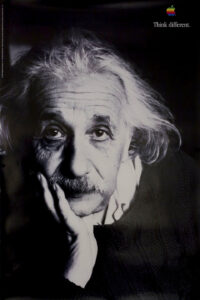
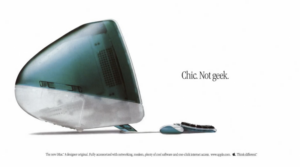
Over the decades, agencies have been both blessed and challenged by the fact that Apple kept evolving, revolutionizing, and reinventing the world and its place within it. From the phoenix-like rebirth of the brand with 1997’s “Think Different,” which harnessed iconoclasts from Einstein to Ali. There were the kaleidoscopic campaigns that introduced the iMac G3, candy-colored pieces of industrial design that positioned Apple as the “anti-beige,” literally and figuratively. And “Get a Mac,” which personified the operating systems of both Apple computers and their awkward PC counterparts, demonstrated why Macs were for real people who behaved like, well, people.

And all of this would be phenomenal if Apple simply stuck to computers.
Which of course they didn’t do.
In 2001, Apple placed “1,000 songs in your pocket” with the introduction of the iPod, untethering people from their computers and leaving them free to dance to their own tune — epitomized by the legendary “Silhouettes” campaign. Dark shadows danced across hypercolor backgrounds, with Apple’s soon-to-be ubiquitous white headphones standing out in sharp contrast. Not only did this campaign help the iPod become the MP3 player to own, it also introduced the world to exciting new artists — whose music you could purchase through Apple’s other grand innovation of the era, the iTunes Store.
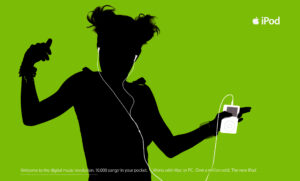
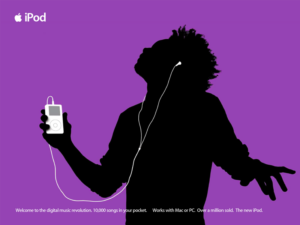
And yet, even then Apple was just getting started. In 2007, it dropped the word “computer” from its corporate name, cementing its shift towards becoming a technology company and one of the most impactful consumer brands on earth. And as if to hammer this evolution home, Apple unveiled arguably its grandest creation, the iPhone. Launched with the memorable “Hello” commercial during that year’s Oscars, the iPhone didn’t merely upend the smartphone category forever, it birthed an entire ecosystem of Apple software and hardware — from the App Store to AirPods to Apple Watch and more — and invited the entire world inside to play.
Furthermore, the iPhone placed powerful creative tools in the hands of would-be photographers and filmmakers, leading to one of Apple’s longest-running global campaigns. “Shot on iPhone” has been harnessing user-generated content since 2015, showcasing its products’ capabilities on some of the biggest platforms imaginable, in every corner of the globe.

Half a century since its inception, the Apple brand continues to innovate and set new standards. Beyond the hardware and software — they continue to innovate desktop and laptop computers, and the iPad has become the world’s de facto tablet — Apple has expanded into areas not even conceived in those early days of Silicon Valley. By creating its own physical Apple Stores, the brand has taken the unique aesthetic of its products and put it into architecture, interior design and customer experience, transforming retail locations into creative and cultural hubs. And Apple TV may have begun as a device in one’s living room, but it became a bridge to Apple’s own entertainment empire, with many acclaimed TV shows and films to its name. Even Apple’s packaging makes every unboxing an experience that unique to the brand.
Across decades of landmark advertising, Apple has done far more than sell computers, music players or phones. From a hammer thrown at conformity to silhouettes dancing against fields of color, from two computers made human to photographs and films captured by real consumers, the brand has consistently expressed the belief that technology should empower us to think, make and live differently. Apple built tools for the crazy ones — and a brand that made the rest of us want to join them.